
-
 Analysis of 2026 global agriculture: climate challenges like snow droughts, commodity market trends, policy shifts from China's Five-Year Plan, and technology's role in sustainable farming.
 -
 Two-time Olympic women’s singles badminton champion Zhang Ning visited Guolian Shares.
 -
 At the beginning of 2025, the construction of Shanghai International Shipping Center has achieved a "good start", and a number of core data have reached a record high in the same period. Railway Luchao Port Station sea-rail intermodal transport business is busy, January-February container processing volume increased by about 15% year-on-year, an increase of nearly 50% during the Spring Festival. The number of international ship inspections in the Yangshan Port Area increased by 11% year-on-year. Shanghai Customs supervised 7281 ships in the first two months, with an average of more than 120 ships per day, an increase of 2.4 percent year-on-year. Enterprises in the hinterland of the Yangtze River Delta have adopted the "one box to the end" model to efficiently connect maritime and railway transportation, demonstrating the continuous improvement of the energy level of Shanghai's international shipping hub.
 -
Iran's Islamic Revolutionary Guard announced on March 5 that in a state of war, Iran has the right to control the passage of the Strait of Hormuz and prohibit the passage of military and commercial ships from the United States, Israel and European countries. Violators will be hit. On the same day, Iran claimed that its naval fighter jets had hit an American oil tanker in the Persian Gulf. However, the Iranian side also clarified that it has not completely closed the strait, and still treats transit ships in accordance with international agreements, and only intercepts warships disguised as merchant ships. The move has heightened tensions in the key waterway.
-
 In March 2026, China's hog industry faces severe losses as prices plummet 28.9% below cost. Oversupply and weak post-holiday demand create a prolonged market crisis with industry-wide implications.
 -
In order to consolidate its technological advantages, the South Korean government will invest 320 billion won in 2026 to support technology research and development in the shipbuilding industry, up 23% year on year. The funds are mainly invested in three major areas: environmental protection ships, AI autonomous navigation ships and localization of marine equipment, aiming to cope with international competition and enhance the overall competitiveness of the industrial chain. The move is part of the "Agreement to Ensure Super Gap Competitiveness" signed between the South Korean government and the three major shipping companies, marking a large-scale strategic investment in the future technology of the shipbuilding industry.
-
Analysis of 2026's feed and dairy sectors: stable grain supplies, EU-China dairy trade tensions, and growing focus on sustainability and innovation in agriculture.
-
Shandong Xinneng Shipping Industry is rushing to produce 182TEU pure electric container ships built for France's Dafei Shipping Group at full capacity, which is its key order to enter the international high-end market. The ship uses Ningde era replaceable batteries, which can reduce carbon dioxide emissions by 778 tons per year. It is planned to be delivered and put into operation in Vietnam's inland river after launching in March. The company meets EU standards through innovative shipbuilding models and smart technologies, and has successfully exported new energy ships to Vietnam, Tanzania and other countries, demonstrating the international competitiveness of China's green ship technology.
-
Analysis of China's March 2026 feed protein market: Cottonseed meal prices rally on tight supply & substitution demand, while soybean and rapeseed meals face bearish pressure from global surpluses.
-
After the Spring Festival, the Beijing-Hangzhou Grand Canal, the key hub of the northern Jiangsu section of the Huai'an lock ushered in the shipping peak. In order to cope with the surge in ship traffic, the lock has greatly improved the efficiency and safety level of navigation through multiple measures such as optimizing the operation of the intelligent scheduling system, opening up green channels for key materials, and providing all-weather convenient services. Within five days, the average daily release of more than 300 ships, through the volume of more than 770000 tons, a strong guarantee of the enterprises along the line to resume work and production of material transportation needs.
-
Analysis of China's 2026 grain & oil market under new policy directives, covering oilseed diversification, soybean import reliance, feed sector challenges, and March outlook.
-
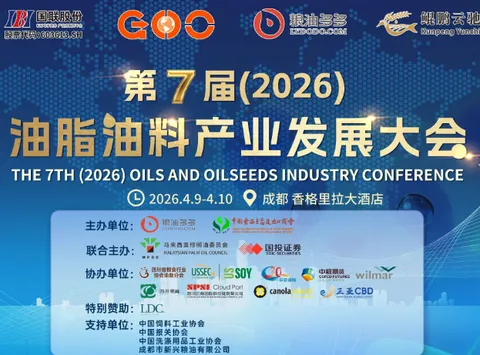 The 7th (2026) Oil and Oil Industry Development Conference Schedule Release
 -
Analysis of China's feed market in early 2026: soybean meal trades at 2,936 RMB/ton with cautious optimism, while corn shows slight gains. Key factors include post-holiday restocking and supply chain dynamics.
-
On February 22, Wutongqiao District, Leshan City, Sichuan Province successfully launched two Leshan-made LNG distribution dual-purpose ships "Yuyang 8" and "Yuyang 9". The two new energy ships were constructed by Leshan Qianwei Chuanqian Shipyard and belong to Leshan Hengbang Port Co., Ltd., with a total length of 66 meters and a maximum load of 1600 tons. They are powered by liquefied natural gas (LNG) and have a range of up to 1000 kilometers. They will mainly sail in the Minjiang River, Jinsha River and the main waters of the Yangtze River. This launch marks an important step in Leshan's green and intelligent shipbuilding and the development of modern water transportation using the Minjiang River waterway.
-
 A breakthrough fermentation technology enables safe replacement of 15% soybean meal in feed, cutting costs by $12-15/ton and reducing antibiotic use by 50%. Commercial rollout begins 2026.